
 Translate
Humber Research Team Conference 2025
Published: 09 December 2025
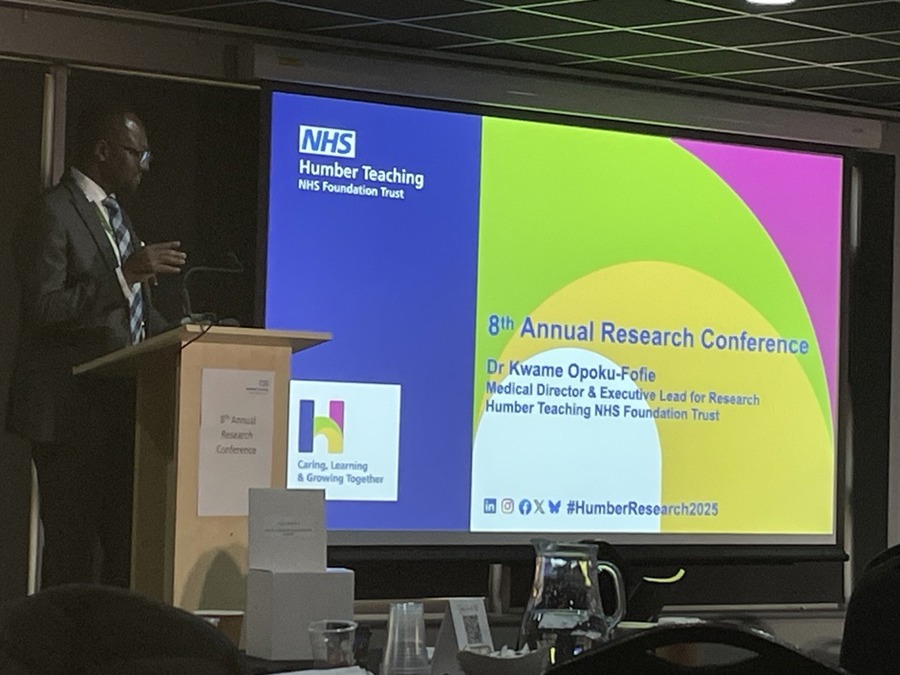
Humber Teaching NHS Foundation Trust’s Research Team organise their annual Research Conference to share the incredible work taking place every day into health research and practice. As part of the day, the team shared a unique insight into a week in the life of Research showing the diversity of roles within the team, but also the breadth of research the Trust is involved in and the positive impact it has had on those who have taken part. View their video.
This year’s conference marked its 8th year and was held at the MKM Stadium in Hull.
Research is recognised by the Trust as an incredibly important step to improving our services and supporting our patients. It has also become one of the many reasons top professionals choose to work for Humber, they have access to such a strong programme of research, supported by an excellent team.
The event began with an opening from the Trust’s Medical Director and Executive Lead for Research, Dr Kwame Opoku-Fofie. Then, the first talk came from Dr William Bird MBE, a GP with over 35 years’ experience. Dr Bird captivated the room with a look into how health is based on the happiness and safety of an individual. By realising the negative effect a lack of safety and heightened levels of stress can have on a person, particularly in children, we can start to address root causes of disease.
Anthony Hurd joined from the HEY Smile Foundation and highlighted key insights and learnings from looking into green and blue health. His work with the Trust’s Dr Hannah Armitt as Clinical Lead focusses on levels of health inequalities and their link to green or blue social prescribing. Green health is linked to being in nature, surrounded by green spaces and connection to the earth. Whereas blue health is how the sea and water can support wellbeing.
One of the Trust’s major research projects currently was then discussed by Dr Austen El-Osta from Imperial College London, who we have partnered with to investigate the impact and location of loneliness and isolation in Hull. Demonstrating the difference between loneliness and isolation, Dr El-Osta explained loneliness is an unmeasurable feeling whereas social isolation is measurable in the number of contacts people have. The project is still ongoing and people can participate at the provided link.
Karolina Klepanska-Czerwinska gave attendees a personal insight into what it means to navigate the UK health system when you are not originally from the UK. Explaining how differences in the way healthcare is provided and received can be a barrier for patients to feel comfortable in NHS healthcare settings. By addressing these obstacles we can reduce negative experiences for those patients. For example, if someone has not previously used UK healthcare there will be no medical records for them, which can have implications should they need urgent care in an emergency department.
Next came a presentation on the SPIRE research Project. Looking at perinatal mental health and parent-infant relationships, Melanie Lowe (Perinatal Peer Support Worker) shared her deeply personal experience. Her insights provided poignant context on why the SPIRE research project was so vital for families and children.
Professor Emma Wolverson, Prof of Ageing at University West London and Dementia Research Lead at Dementia UK explained how family interventions can be key in dementia patient outcomes. Some people diagnosed with dementia are sectioned and require treatment in a mental health inpatient ward. The study is finding how family and carer involvement can improve the experience of them and the patient.
After lunch, Prof Thomas Phillips updated on the progress being made by the Centre for Addiction and Mental Health Research (CAMHR) based at the University of Hull. The Centre is a collaboration, which includes Trust staff, looking at the relationship between addictions and mental health.
Dr David Zendle and Prof Florian Block from the University of York then shared their innovative solution for collating digital data which can be used for future research projects. The idea of data donation is to support research projects through this new Smart Data Donation Service.
Heidi Fewings, Children’s Prevention and Early Intervention Lead for the Trust shared her own research project which looked at young people’s experience of violence against women and girls in the UK. She highlighted concerning trends that young people find it difficult to distinguish between what is considered ‘banter’ and what is harassment, demonstrating a high level of tolerance of bad behaviour. Summarising the prevalence of this problem, Heidi shared, “We run the risk of it becoming so commonplace that we lose the ability to recognise it.”
The final presentation came from Caroline Brundle and Anne Heaven who shared two ageing research projects looking at digital exclusion and osteoporosis in older people. Digital exclusion has been shown to be a social determinant of health, yet they found through their research that 53% of the sample did a lot of online activity. Looking at osteoporosis in older women, Anne’s research found that people were not openly speaking about it and, in many cases, once medication was given they were left to manage themselves.
The conference highlights can be viewed on the Trust’s YouTube Channel.


